We started our walking tour, again led by Jasmin, at the Koutoubia mosque. It is a large 12th century mosque, still in use today.
Next we visited the El Badii Palace which was quite large, but very much in ruins. The sunken garden containing orange groves, however, still flourishes. It was built in the16th century and although it was a palace, part of the underground rooms that housed the servants, also served as a prison.
The second palace of the day, Bahia Palace, was smaller (only 160 rooms and courtyards and 8 acres of gardens) and newer (19th century). It was also much better preserved. Everywhere we wandered, we admired the intricately detailed mosaics, carvings, ceilings, courtyards, fountains, garden... there was no end of allure.
Our first museum was the Museum of Tiskiwin. A small museum of Berber history and artifacts. It was quite interesting.
Dar Si Said, the final museum of the day, was a museum of Moroccan carpets. Videos and tools explained and demonstrated the carpet making process from shearing the sheep to weaving the final product. The patterns, colours, and weaving styles vary from region to region, making the origin of a carpet easier to identify. It was pretty cool.
Pool Day
Today we split up for a bit. Some went to the Photography Museum, while others stayed at the riad.
The museum goers rode in a tuk-tuk that took them the "scenic route" to the museum.
The rest of the day was spent hanging by the pool. (It was open!)
The museum goers rode in a tuk-tuk that took them the "scenic route" to the museum.
The rest of the day was spent hanging by the pool. (It was open!)
Exploring Marrakesh
Today we started a walking tour to explore Marrakech, led by Jasmin. It started with our first stop closed for renovations (a common theme during this trip), but that didn't deter us. We moved on to the Marrakesh museum which was a combination historical and modern art exhibits. An artist on site painted the girl's name for them in Arabic calligraphy.
Afterwards we wandered through the alleys of the souk that opened on to a big main square with spices, and produce, and...snakes!
We wanted to end the day in the pool, but it was closed. Friday. We'll try again tomorrow.
Road to Marrakesh
Our drive out of the desert took us through the City of Roses. Here they grow and harvest roses to make rose water and rose oil products. One kilo of rose petals produces 1L of rose water. Four tons are needed to make 1L of oil!
Along the way, in the distance, we could see the tower and reflections coming off the world's largest solar array situated in the desert.
We made a quick stop in at the Atlas Studios and glimpsed some old sets and props from their various movies.
Further down the road we stopped at Ait Benhaddou and climbed to the top. It's a 17th century ksar (fort) built in the foothills that was used in the filming of Gladiators and Game of Thrones.
Our last stop before descending through the Atlas mountains was to see an Argan oil demonstration. Argan trees are almond or peanut-type trees that are native only to Morocco. The nuts are harvested to make cosmetic hair and skin products, cooking oil, and edible butter.
The road through the mountains was a little harrowing as most of the winding route was under construction and Moroccans have a different style of driving than we do. The majestic views, however, were amazing.
Reaching Marrakesh, the end of our desert trek, our driver dropped us off at our new temporary home. A riad (with a pool!) just outside the Old Town.
Oasis
The night in the Sahara was very comfortable in our luxury tents, complete with flushing toilets and a shower. Since it was after midnight when we went to bed, we opted not to get up to watch the sunrise over the dunes. This didn't make that big of a difference to our plans to sleep in since hiding from the sun in the desert is pointless. It wasn't long before our tent was perforated with sunlight. After an early breakfast, we explored the area near our camp for a while, but that inescapable sun was also heating things up and it was already 41°C by 8:30am.
Rather than commute back to town by camel, we decided to pile into a SUV and be shuttled back. I must say, bounding over the dunes in this 4x4 was not for the faint of heart. It rivaled any white knuckle rollercoaster ride I've ever been on in The West.
Back in town, we climbed into our waiting van to continue our exploration through the desert.
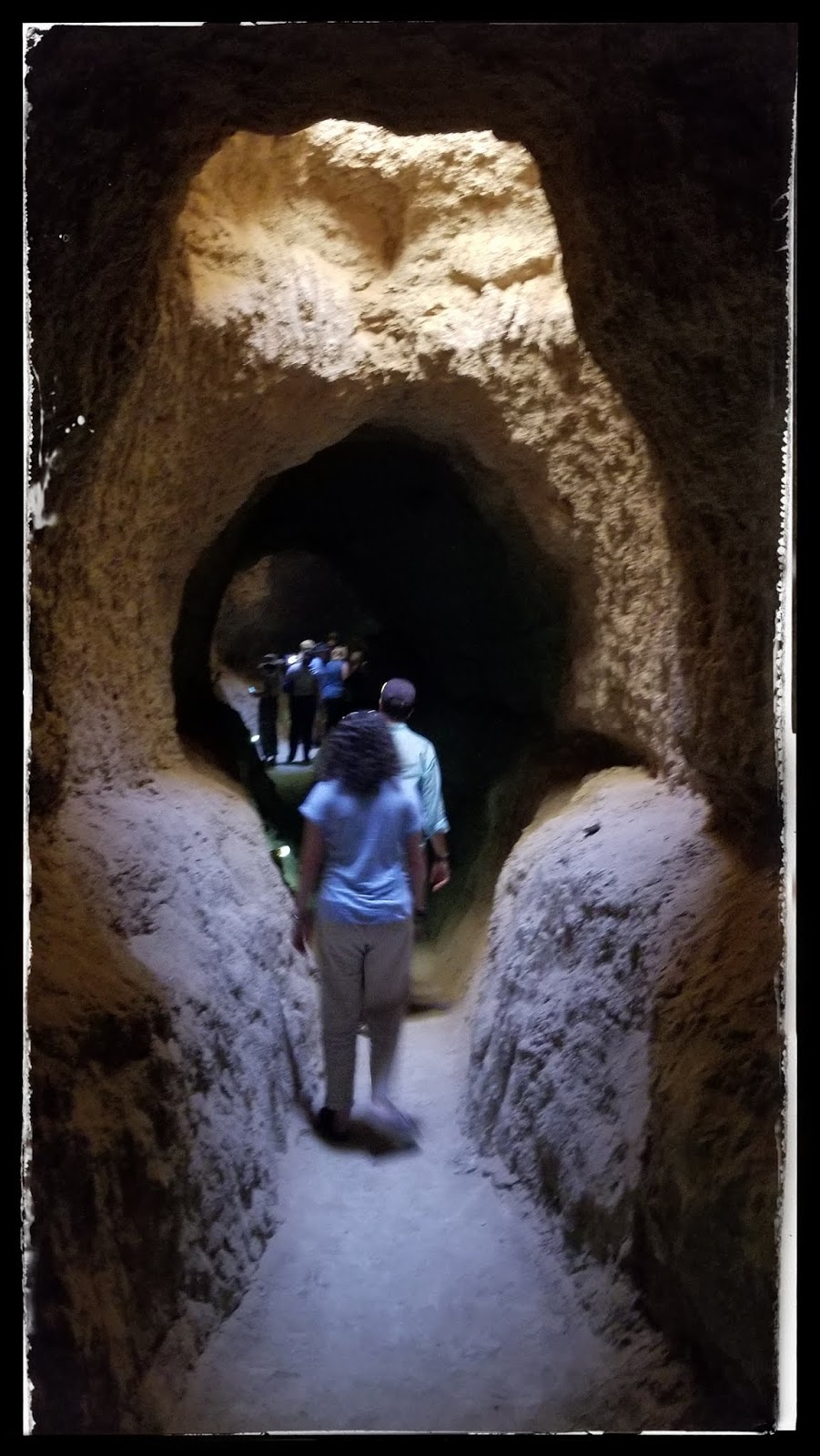
We stopped to check out a now defunct underground water canal, called a qanat, that had been hand dug as early as the 14th century and maintained as recently as 1970. Qanats are gently inclined horizontal tunnels dug into sloping terrain, as opposed to a vertical well dug straight to the water table. They were used to transport water vast distances to some of the oases in the desert.
As we continued to drive, the seemingly flat vista would fall away to reveal a deep gorge oasis carved into the landscape by a river that has eroded and nourished the parched desert soil for centuries.
It's fascinating how quickly and dramatically a water source can turn the dusty, dry, rocky land into a lush, green, Palm grove.
Our hotel for the night, overlooks one of these flourishing oasis.
Into the Desert (all the way)
This morning we started our trek into the desert. Our guide/driver loaded us into his van bright and early and we headed off.
Our first stop was in Ifrane for breakfast. The Moroccans call the town "The Swiss Alps" or "European Town" of Morocco. It is up in the Middle Atlas mountains, so it gets snow. Because of the snow, the houses all have steep peaked roofs (evoking Swiss or European resemblance) rather than the flat-roofed, box-like homes seen everywhere else. They even have a Ski Station up here, but apparently they have no proper machinery to clear the roads, except of course, for the king, who does come to ski.
Not far from Ifrane, we stopped on the side of the road to feed monkeys. They were very accustomed to tourists and had no fear approaching us for food (cherries and peanuts). One was bold enough to snatch the bag of peanuts out of Dave's hand before he had a chance to open it.
After a long drive through the mountains and into the desert we finally reached Merzouga.
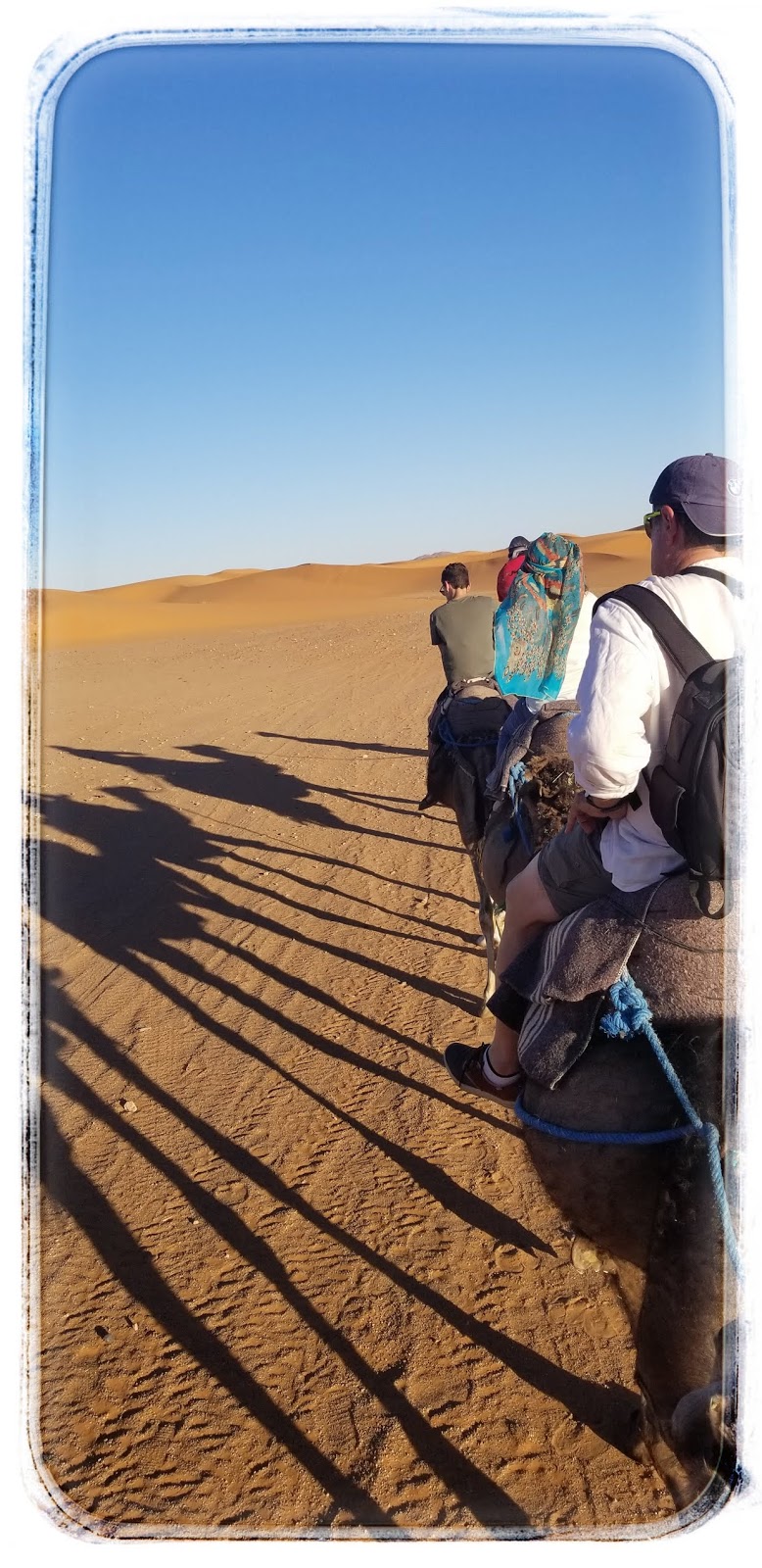
We traded the luxury of our AC van to climb on top of camels and head into the hot, dry sand dunes of the Sahara. In a short time, our camel guide led our little caravan where we could no longer see the town and were surrounded by sand banks. We did not feel that we were alone, however, other camel caravans could be seen in the distance and the occasional ATV would pop over a ridge and disappear again.
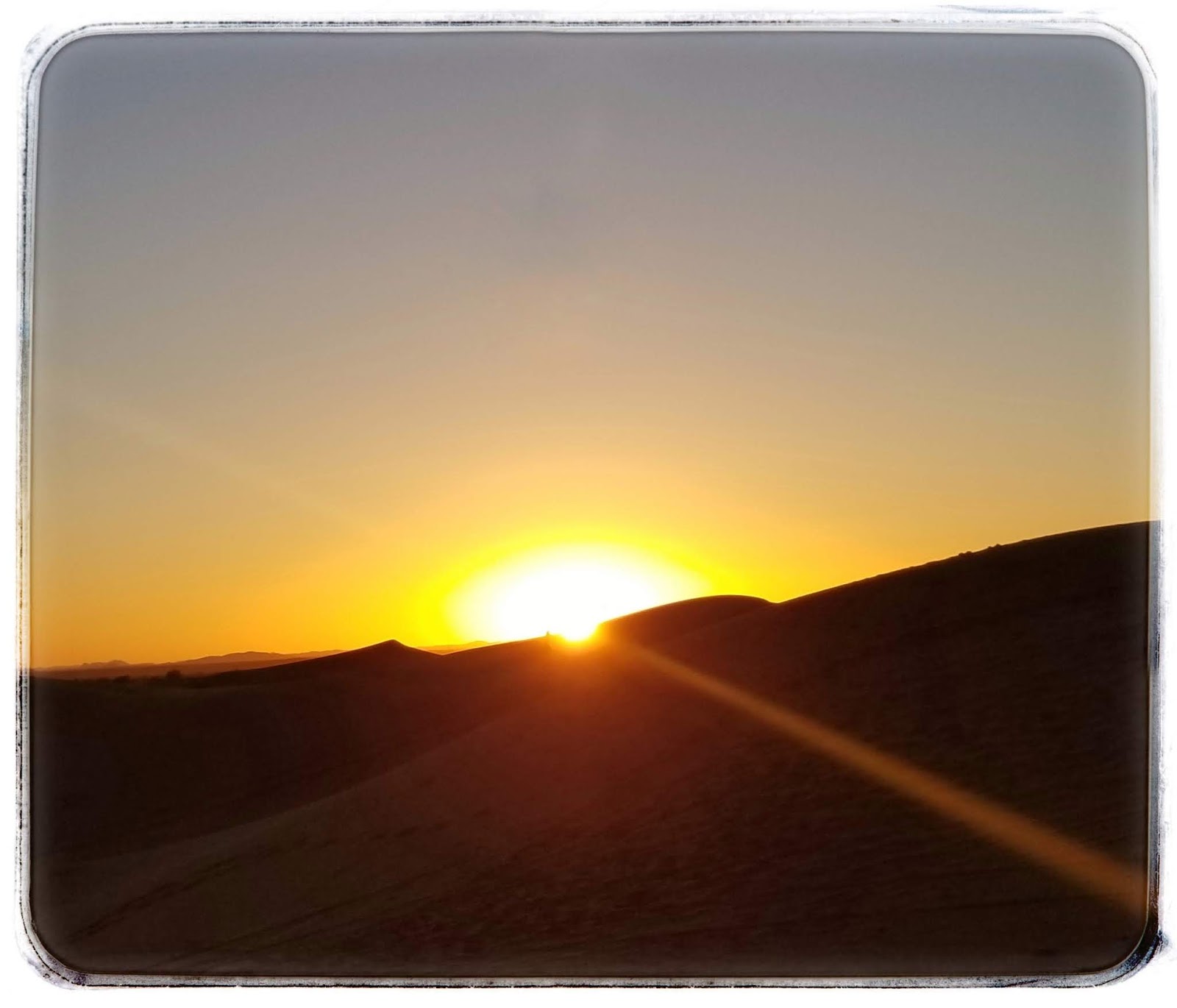
Before reaching camp, we stopped to climb a little higher by foot, to a ridge to watch the sunset.
Some couldn't resist playing in the giant sandbox.
When we reached our camp, tea was, of course, served.
In the evening, after a tradional Berber dinner we stepped away from the light of our camp to star gaze. The sky was magnificent; suffused with so many celestial beings!
Before bed, we sat around a camp fire and listened while our Berber hosts played drums and sang songs. We even did a little dancing and drumming too.
Henna and Weaver
Today was our last day in Fes.
We returned to the souk to have Henna tattoos put on the girls hands. As a little bonus, the artist also wrote each of the girls' names in Arabic.
While they were getting painted, we admired more of the detailed Fes architecture.
Afterwards, we were led upstairs in a textiles shop to watch weavers working away on the looms. Once again, we admired the craftsmanship of the beautiful fabric created.
Our last dinner in Fes was at a rooftop restaurant that looked across the whole Old Town. We watched the sunset over the city and even spied our palace room in the distance.
Subscribe to:
Posts (Atom)